


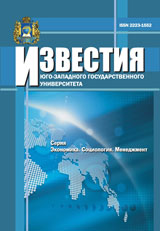
Scientific peer-reviewed journal “Proceedings of the Southwest State University. Series: Economy. Sociology. Management“ is a subscription printed periodical publication that publishes materials containing the results of fundamental, problem-oriented scientific research in such areas as economic, philosophic and sociologic sciences. The main content of the journal includes scientific papers, scientific reviews, scientific critical reviews and comments.
The journal is registered as a mass media by Federal Service for Supervision in the Sphere of Communications, Information Technology and Mass Communications (certificate of registration PI No. FS77-82284 dated 11/23/2021).
Journal founder is Federal State Budgetary Educational Institution of Higher Education «Southwest State University».
The journal is published in printed form with a frequency of 6 issues per year. Mandatory copies of the journal are sent to the Information and Telegraph Agency of Russia (ITAR-TASS). In printed form the journal “Proceedings of Southwest State University. Series: Economy. Sociology. Management in printed form is distributed throughout the Russian Federation, as well as abroad by subscription. Subscription index according to the Unified catalog "Press of Russia" - 44284.
The journal is included in the list of leading scientific journals and publications of State Commission for Academic Degrees and Titles of the Ministry of Education and Science of Russia in the following scientific areas:
5.2.1. Economic theory (economic sciences).
5.2.2. Mathematical, statistical and instrumental methods in economics (economic sciences).
5.2.3. Regional and sectoral economics (economic sciences).
5.2.4. Finance (economic sciences).
5.2.5. World economy (economic sciences).
5.2.6. Management (economic sciences).
5.4.2. Economic Sociology (sociological sciences).
5.4.4. Social structure, social institutions and processes (sociologic sciences).
5.4.6. Sociology of culture (sociologic sciences).
5.4.7. Sociology of management (sociologic sciences).
5.7.2. History of philosophy (philosophic sciences).
5.7.6. Philosophy of science and technology (philosophic sciences).
5.7.7. Social and political philosophy (philosophic sciences).
5.7.8. Philosophical anthropology, philosophy of culture (philosophic sciences).
The journal is open to all interested individuals and organizations. The Editorial Board of the journal is constantly working to expand the range of authors, attracting scientists from Russia, near and far abroad.
The Editorial Board of the journal only accepts for consideration articles which were not previously published and not intended for simultaneous publication in other editions.
The journal follows an open access policy. Full-text versions of articles are available on the website of the journal, scientific electronic library eLIBRARY.RU.
Editorial policy is based on compliance with the requirements of publication ethics.
Publication of articles in the journal is FREE for authors. The Editorial Office does not charge authors for the preparation, placement and printing of materials.
Target audience: researchers, teaching staff of educational institutions, the expert community, young scientists, graduate students, doctoral students, interested members of the general public.
Current issue
MANAGEMENT IN SOCIO-ECONOMIC SYSTEMS
Relevance. Anti-Russian sanctions have a destructive impact on the economy, negatively affecting the sustainability of enterprises, which attracts special attention to the problem of bankruptcy in the context of improving the effectiveness of management in general and crisis management in particular.
The purpose is identify the relationship between the dynamics of corporate bankruptcies and the effectiveness of crisis management at the micro and macro levels, as well as to develop approaches to interpreting statistical data on insolvency to assess the quality of management decisions.
Objectives: to analyze the dynamics of corporate bankruptcies in the Russian Federation in 2015-2025; to identify key trends and structural shifts in bankruptcies; to systematize the approaches of various stakeholders to assessing the state of business; to develop proposals on the use of bankruptcy statistics as an indicator of the effectiveness of crisis management.
Methodology. The research is based on a systematic approach to the analysis of insolvency phenomena. Statistical analysis methods were used to process Federal Resource data (horizontal analysis, structural shift analysis), and a comparative analysis method to compare the approaches of different stakeholders.
Results. It was found that the number of bankruptcies of legal entities in Russia in 2025 decreased. Indicators of declining sustainability for different groups of stakeholders are systematized: market, operational, investment, financial, managerial and organizational features are identified for owners and management; a trigger analysis model is proposed for creditors; an algorithm for identifying signs of "objective bankruptcy" is proposed for arbitration managers.
Conclusions. The dynamics of bankruptcies is an important, but not the only indicator of the effectiveness of crisis management. A decrease in the number of bankruptcies of legal entities may indicate both a successful anticrisis policy (including a moratorium on bankruptcy) and the conservation of inefficient enterprises. The necessity of an integrated approach to the interpretation of bankruptcy statistics, considering industry and regional specifics, as well as the interests of various stakeholders, is substantiated. The proposed recommendations can be used to improve the crisis early warning system and increase the effectiveness of anti-crisis management of organizations.
Relevance. In the context of growing globalization and constant transformations of our society, the need to introduce new tools (or subjects) to meet the social needs of the population (taking into account the implementation of the social policy of the state and charity in Russian territories) is actualized. One of these is social enterprises, which are aimed not only at commercial, but also at the social effect within the framework of their activities. These agents of economic activity not only produce the necessary goods for the population or provide services, but also have an additional social effect, which can be expressed in the employment of persons from socially vulnerable categories, the sale of products created by the hands of persons from socially vulnerable categories or in the creation of goods for persons with disabilities of different orientation (under this federal law).
The purpose is to formulate our own author's approach, to present a conceptual diagram of the application of the economic and qualimetric approach to assessing the performance management of social enterprises.
Objectives: analysis of existing scientific and practical approaches; formation of author's (economicqualimetric) approach; creation of conceptual diagram of application of economic-qualimetric approach with designation of significance and necessity.
The methodology within the framework of this article is expressed in the analysis and synthesis of scientific approaches, a retrospective study, the possibility of docking different sciences to form a conceptual diagram of the application of the economic-qualimetric approach.
The results are expressed in the formation of a conceptual diagram of the application of an economic and qualimetric approach to assessing the performance management of social enterprises in practice, taking into account the uneven application of business models, micro and macro conditions of activity.
The conclusions show the importance of the development of social entrepreneurship in Russia, as well as the need and relevance of assessing the effectiveness of social enterprises.
ECONOMIC POLICY AND MECHANISMS OF ITS REALIZATION
Relevance. Government policy in relation to mass media is a complex and multifaceted phenomenon. An understanding of public policy in the media sphere is necessary to understand the modern challenges of information security. Sanctions, cyber attacks, the fight against "fake news" – all these phenomena are closely intertwined with the regulation of the media space.
The purpose is to analyze the state policy in the field of press and mass media on the example of the Kursk region through legal, economic, and administrative methods of its implementation, as well as an assessment of the resource provision and implementation of the state program in this area.
Objectives: to consider the theoretical aspects of the formation of mechanisms and tools for the implementation of state policy in the media; to evaluate legal documents reflecting the direction and progress of the implementation of state information policy in the Kursk region; to identify problematic aspects of state regulation of mass media in the region and ways to optimize.
Methodology. The research is interdisciplinary in nature, combining legal, sociological, and managerial approaches, and is based on the empirical basis of official statistics, which ensures its reliability and practical focus.
Results. The article reveals the directions of studying state policy in the media, analyzes the activities of the state program in the Kursk region, and examines the effectiveness of ensuring effective information policy in the region.
Conclusions. It has been proved that, despite the formal implementation of the state program in the media in the Kursk region, the full utilization of the budget and over-fulfillment of a number of quantitative indicators, the level of public satisfaction with information coverage remains consistently low and is growing extremely slowly, which indicates a gap between administrative efficiency and real social impact, the need for a flexible strategy based on digital technologies, transparency and citizen engagement.
Relevance. The development of creative industries is recognized as a key factor in economic diversification, stimulating innovation and ensuring sustainable growth, especially in the context of reducing dependence on traditional commodity sectors. The Russian Federation is developing a system of state support for this sector, but its effectiveness and balance require scientific analysis and evaluation.
The purpose is to identify and systematize the key areas, mechanisms and contradictions of state support for the development of creative industries in the Russian Federation at the federal and regional levels.
Objectives: to analyze existing theoretical approaches to the definition of creative industries; to structure the main areas of state support; to evaluate the effectiveness of federal support measures; to explore and typify regional support models using the example of subjects of the Central Federal District.
Methodology. The research uses methods of systematic and comparative analysis, content analysis of regulatory and strategic documents, expert assessment method for the analysis of support measures, as well as analysis of statistical data and regional cases.
Results. Six key blocks of government support for creative industries have been identified and evaluated. It is established that an asymmetric framework and investment model has been formed at the federal level, characterized by a developed strategic framework and financial instruments with a critical lag in the infrastructural, technological, educational and human resources blocks. The phenomenon of "coordination inconsistency" has been revealed due to the lack of a single center of responsibility. At the regional level (using the example of the Central Federal District), compensatory support models have been identified and typologized: "industry-based", "diversified ecosystem", "personnel-oriented", "cultural and tourist". A key systemic contradiction has been identified between the declared strategic goals and their instrumental implementation, which focuses on compensatory and stimulating rather than environment-forming measures.
Conclusions. The effective development of creative industries in Russia requires a transition from a framework investment model to a holistic ecosystem policy. It is necessary to overcome institutional inconsistencies, strengthen the environment-forming blocks, as well as adapt the regulatory framework to the specifics of creative entrepreneurship, including the introduction of flexible regulatory regimes. Regional compensatory strategies demonstrate potential, but their effectiveness is limited by the "regulatory ceiling" of federal legislation.
THE GOVERNMENT AND BUSINESS ON THE PATH OF THE DIGITAL TRANSFORMATION
Relevance. The digital transformation of housing and communal services is one of the strategic priorities for the development of the urban environment in Russia. Despite the steady growth of the housing and communal services market, the industry is facing high depreciation of funds, non-transparency of settlements and the growing demands of citizens on the quality of services. Existing approaches to assessing the effectiveness of digitalization are fragmented, which makes it difficult to manage transformations and justify development programs. In this regard, the development of a comprehensive criterion for assessing the digital transformation of housing and communal services is an urgent scientific and practical task.
The purpose of the work is to develop and substantiate a comprehensive criterion (integral index) for evaluating the effectiveness of the digital transformation of the housing and communal services sector, which makes it possible to uniformly measure the results of the introduction of digital technologies in the industry.
Objectives: to analyze existing definitions and approaches to the digital transformation of housing and communal services; to identify and systematize performance criteria proposed in the scientific literature; to develop a multi-factor complex criterion with weights and an interpretation scale.
Methodology. The research is based on an analysis of regulatory legal acts, scientific publications by Russian authors, as well as methods of comparative analysis, systematization and multi-criteria aggregation of indicators.
Results. The existing criteria for the effectiveness of digital transformation of housing and communal services are applied separately, without a single methodology. A complex criterion is proposed – an integral index combining five blocks of indicators with weighting coefficients. An interpretation scale has been developed, which makes it possible to evaluate the digital transformation of housing and communal services in different municipalities.
Conclusions. The developed comprehensive criterion is a practice-oriented tool for monitoring and managing digital transformations in the housing and communal services sector. It allows us to assess the current level of digital transformation.
ACTUAL PROBLEMS OF REGIONAL SOCIO- ECONOMIC SYSTEMS DEVELOPMENT
The relevance of this study is determined by the fact that monetary policy aimed at inflation targeting conflicts with the need for technological modernization in the real sector, creating a critical debt burden on industry. Under these conditions, regional investment policy requires revision to ensure a balance between maintaining the financial stability of enterprises and stimulating long-term capital investment in a new technological paradigm.
The purpose of this study is to substantiate the directions for transforming regional investment policy aimed at reducing the debt vulnerability of the real sector and ensuring its financial stability during the transition to a new technological paradigm.
The objectives of the study are to assess the dynamics of the debt burden of enterprises in the real sector and identify areas for restoring investment activity.
Methodology. The research methodology is based on a combination of general scientific and specialized research methods, including systems, structural-functional, and comparative analysis, as well as statistical processing and data visualization methods.
The results of the study confirm that the current conditions for attracting borrowed capital are associated with prohibitively high debt servicing costs, making large-scale capital asset renewal and modernization of production capacity impossible. It was found that a review of manageable internal factors, primarily monetary and fiscal policy parameters, and the implementation of targeted measures to stimulate consumer demand are key to increasing the financial stability of the real sector.
Conclusions. The findings of the study indicate that maintaining a strict focus on inflation targeting without taking into account sectoral and regional specifics leads to the accumulation of debt vulnerabilities in the real economy and a reduction in investment incentives.
Relevance. The current stage of development is due to the need to form new approaches to strategic planning of both the Russian Federation and its regions, taking into account the conditions of geopolitical challenges, digital transformation and the achievement of technological leadership. The established strategic planning system requires adaptation and flexible approaches when using the existing unique potential of the regions, taking into account modern challenges and assessing the effectiveness of the implementation of past strategic documents at the regional level.
The purpose is to study the evolution and directions of development of the strategic planning system at the federal and regional levels in the new economic conditions.
Objectives: to conduct a retrospective analysis of the stages of formation of the strategic planning system in Russia; to identify key trends and vectors for the development of strategies for socio-economic development; systematize the strategic documents of the regions of the Central Federal District and determine their sectoral specialization; justify the need to introduce new management approaches to improve the effectiveness of strategic planning.
Methodology. The methodological framework includes a combination of qualitative and quantitative research methods using historical and comparative analysis, a structural-functional approach, retrospective and prospective analysis.
Results. A retrospective analysis of the evolution of strategic planning in Russia was carried out, five stages were identified: from the first planning attempts during the transition period of 1991-1993 to the modern stage of hybrid development, which began in 2024. The dynamics of the index of globalization of cities and the competitiveness of countries were analyzed, the place of Russia against the background of world leaders was determined. The strategic documents of the regions of the Central Federal District were systematized, their integration with federal documents and industry specialization were revealed.
Conclusions. The promising implementation of strategies until 2036 will be determined by the ability of the regions to combine technological breakthrough with socio-economic stability, economic growth with environmental constraints and digital transformation of management with the development of human capital. Only with effective cooperation and regular updating of strategies is it possible to achieve strategic goals until 2036.
Relevance. Intellectual property is a key intangible asset and a driver of innovative development in the modern economy. The need to create an effective system of innovative economic development is conditioned by the need to stimulate investment in research and development, preserve the competitive advantages of companies and counter violations that harm both individual business entities and the economy of the country as a whole. The potential for economic development directly depends on increased activity in the field of development and innovation.
The purpose is to explore the conceptual framework of intellectual property, analyze and evaluate the state and dynamics of patent activity in the Central Federal District.
Objectives. The main objectives of the research are: to evaluate statistical indicators of patent activity in the Central Federal District and in the federal districts; to develop practical recommendations for enhancing activities in the field of intellectual property.
Methodology. The study used a general scientific approach, generalization, analysis and synthesis to systematically study the legal foundations, technical mechanisms and statistical data in the field of intellectual property.
Results. A high differentiation of patent activity was revealed in the Central Federal District, where Moscow retains the absolute leadership, however, in some regions (Voronezh, Kursk, Smolensk, Tver regions) faster growth rates were recorded. The key drivers of innovation are scientific and medical centers, state corporations and leading universities. A well-developed infrastructure and the availability of targeted regional programs are significant factors in increasing patent activity.
Conclusions. Intellectual property is the basis for the innovative development of the regions. To activate the innovative potential of all subjects of the Russian Federation, a targeted regional policy, financial incentives through tax incentives and effective contracts, as well as measures to commercialize the results of intellectual activity and the formation of regional brands are needed. Strengthening patent activity and translating it into real economic growth require an integrated approach combining legal protection, government support and focus on priority technological areas.
Relevance. The article is devoted to the study of systemic barriers to the introduction of corporate social responsibility in the regions of Russia. The relevance of this work is determined by the discrepancy between the stated objectives of sustainable development and the actual implementation of corporate social responsibility. This gap is especially noticeable when federal and global strategies set high standards, and regional actors, due to lack of resources, poor coordination, and fragmented institutions, are unable to implement them.
The purpose of this work is to create a hierarchical scheme of systemic obstacles to the integration of corporate social responsibility principles in Russian regions.
Objectives: to analyze theoretical approaches to the study of barriers to corporate social responsibility implementation in the international and Russian scientific literature; to identify and classify systemic barriers; to develop their multilevel model; to conduct an empirical study of the manifestation of these barriers; to develop recommendations for stakeholders.
Methodology. The research methodology includes methods of analysis and synthesis, grouping and comparison in the context of guiding the principles of a systematic approach, statistical and rank analysis.
Results: an analysis of theoretical approaches to the study of barriers to corporate social responsibility implementation in the international and Russian scientific literature was carried out; systemic barriers were identified and classified; their multilevel model was developed; an empirical study of the manifestation of these barriers was conducted; recommendations for stakeholders were developed.
Conclusions. The identified systemic barriers to the introduction of corporate social responsibility in the regions of Russia and the developed relevant multilevel model of their manifestation have made it possible to prove that the elimination of the identified barriers is possible only on the basis of a systematic approach, which implies the rejection of unified solutions and the transition to differentiated development models that take into account the specifics of each subject of the Russian Federation.
Relevance. In the context of ongoing institutional transformations to improve governance and reduce intraregional socio-economic disparities in the Kursk region, the most practically effective instrument for regulating spatial development is the renewal of the structure of administrative-territorial divisions.
The purpose of the study is to modernize the conceptual foundations and scientific and practical apparatus for determining strategic directions and development trajectories of municipal districts of the Kursk region based on a comprehensive institutional and strategic analysis of their situation with an explication of target guidelines and key growth vectors, as well as in formulating applied recommendations for improving the regional administrative-territorial structure
Objectives: to deepen understanding of the need for and determinants of state regulation of regional development and the municipal territories that comprise them; to develop innovative tools for multidimensional classification and spatial positioning of territorial units based on the results of a comprehensive assessment of their socio-economic status to determine optimal trajectories and rates of strategic development; to propose a conceptual model for reconfiguring the administrative-territorial structure of districts in Kursk Oblast based on target management and socio-economic symmetry.
Methodology. The spatial development of regions is studied using general scientific methodology and a systems approach, ensuring its multidimensional diagnosis and redesign. Universal analysis and synthesis techniques, topological methods, and specialized analytical techniques of monographic, abstract-logical, economicstatistical, and cluster analysis are employed.
Results. A scientifically based, comprehensive vision for the prospects for socioeconomic development and improvement of the administrative-territorial structure of the Kursk Region has been developed, which has practical implications for strategic planning and management. The revised boundaries envisage the consolidation and enlargement of municipal districts.
Conclusions. Regional and local authorities must be prepared to implement innovations that promote balanced development within municipalities. Research and teaching staff at Southwest State University and the Financial University can ensure the development of an adequate scientific base to support decisions and develop recommendations for modernizing the administrative-territorial division of the Kursk Region and overcoming intraregional socioeconomic asymmetries.
ECONOMICS AND ORGANIZATION OF ENTERPRISES, INDUSTRIES, COMPLEXES
Relevance. The travel industry, being one of the dynamic and competitive sectors of the global economy, faces the need for constant updating in the context of digital transformation, changing consumer preferences and increasing global competition. In this regard, the ability to innovate is becoming a key factor in the competitiveness and sustainable development of tourism enterprises.
The purpose of the study is to develop a scientifically based model of integrated diagnostics of innovative development of tourism companies in the Kabardino-Balkarian Republic.
Objectives: to analyze the existing interpretations of the concepts of "information technology" and "innovation activity" in relation to the field of tourism; to analyze the current state and dynamics of the development of tourism infrastructure and market in the Kabardino-Balkarian Republic; to determine a system of criteria, develop and test a methodology for the comprehensive assessment of innovative activities of tourism enterprises; to analyze the volume, cost structure of innovation in tourism of the Republic; to develop practical proposals for enhancing innovation activities to increase the competitiveness of tourism enterprises in the region.
Methodology. The methodological basis of the research is constituted by the synthesis of systemic-structural, institutional-evolutionary and empirical-diagnostic approaches that form the basis of a multi-paradigm research platform adapted to the specifics of the tourist and recreational complex of the region.
Results. A model of complex diagnostics of innovative development is proposed using the example of five travel agencies of the Kabardino-Balkarian Republic. For this purpose, a system of 10 criteria, weighting coefficients, a verbal description and a point scale of criteria are defined. To enhance innovation and increase the competitiveness of tourism enterprises, the development of unique tourism products, the creation of a unified regional tourist information space, and the promotion of the introduction of resource-saving technologies are proposed.; active implementation of new marketing and management tools and automated management systems.
Conclusions. The results of the study indicate the relevance of the developed conceptual framework for the diagnosis of innovative development of tourism industry enterprises in the regional economic system. The revealed patterns of the dynamics of the tourism infrastructure and the structure of innovation costs create empirical and theoretical prerequisites for improving the methodological framework for assessing the innovation activity of industry systems.
INSTITUTIONAL FACTORS OF ECONOMIC SYSTEMS DEVELOPMENT
Relevance. In the context of resource constraints, climate risks, sanctions and logistical restructuring and geoeconomic fragmentation, bioeconomics is becoming important not only for environmental, but also for industrial and technological development. Its formation is associated with the transition from a linear model of using raw materials to reproducible biological resources, closed cycles and nature-like technologies.
The purpose is to identify the institutional and economic constraints of the development of bioeconomics and to determine the directions of its spatial and sectoral adaptation.
Objectives. The article reveals modern approaches to the interpretation of bioeconomics, compares international and Russian trajectories of its development, defines the limitations of scaling biotechnologies, characterizes the role of regional specialization and formulates measures to reduce barriers to commercialization.
Methodology. The research is based on the analysis of scientific literature, a comparative economic approach, the systematization of statistical and expert materials, as well as the application of elements of institutional and regional analysis.
Results. It has been established that the bioeconomic transition is limited not only by the technological readiness of solutions, but also by a shortage of scaling infrastructure, domestic demand and a coordinated territorial policy. The paper clarifies that what matters for Russia is not universal recipes for sectoral growth, but the alignment of federal priorities with the resource base of specific territories. The expediency of creating interregional scaling centers, introducing moderate quotas for biogenic raw materials, and adjusting regional strategies based on accumulated production competencies is substantiated.
Conclusions. Bioeconomics can become a factor of technological sovereignty and renewal of the industrial base if its development is based on industry cooperation, "smart specialization" of regions and institutional mechanisms for bridging the gap between research and mass production.
PROBLEMS AND PROSPECTS OF THE FINANCIAL SECTOR DEVELOPMENT
Relevance. Under conditions of sanctions pressure and structural transformation of the Russian banking system, systemically important credit institutions face the need to revise their approaches to managing operational efficiency and market value. No adapted quantitative tools currently exist for assessing the impact of internal operational factors on the market capitalisation of publicly traded Russian banks subject to blocking sanctions.
The purposes is to develop and validate a model for assessing the impact of operational efficiency on the market value of a commercial bank, using VTB PJSC as a case study.
Objectives: to systematise theoretical approaches to the relationship between efficiency and bank value; to identify key operational efficiency indicators that significantly affect capitalisation; to construct an econometric model and verify its adequacy using VTB PJSC data for 2015–2025; to propose practical recommendations for applying the model.
Methodology. The study draws on Value-Based Management theory, the Modigliani–Miller capital structure theorem, and the Ohlson model. Correlation analysis, ordinary least squares regression, and Fisher, Student, White, and Durbin–Watson tests were applied. The sample comprises 40 quarterly observations for 2015–2025.
Results. A two-factor regression model was constructed. In the post-sanctions period, the Cost-to-Income Ratio (CIR) proved to be the most significant driver of market value (r = −0,82), exceeding the explanatory power of profitability indicators ROE and NIM.
Conclusions. The research hypothesis is confirmed: under high uncertainty, investors shift focus from profitability metrics to cost-control indicators. The developed model constitutes a practical strategic tool for bank value management.
Relevance. The relevance of this study is driven by the significant transformation of the global financial market, which requires banks to shift from classical risk assessment approaches to the implementation of the sustainable development concept. Amid external sanctions pressure on the Russian economy, and the banking sector in particular, ESG principles have gained particular importance, helping to identify growth points and attract investors from friendly nations. Furthermore, banks' participation in environmental and social projects facilitates long-term economic growth, strengthens the trust of the state and society, and mitigates reputational risks.
The purpose is to identify the prerequisites for the emergence and development trends of ESG banking in current economic conditions.
Objectives. To achieve this goal, the following objectives were set: to systematize the stages of formation and development of the sustainable development concept and ESG principles; to examine the experience of implementing ESG principles and applying ESG banking within the domestic banking system; and to determine the development prospects of domestic ESG banking, taking into account the influence of external factors.
Methodology. The study employs general scientific methods of analysis, comparison, grouping, and data synthesis, as well as tools for the graphical interpretation of the research results.
Results. The domestic model of ESG banking is transforming to meet the modern realities of the country's economic situation by forming an integrated risk management model and creating long-term value. Its further development will depend on the coordination of actions between regulators, the banking community, and the real sector, as well as the ability to adapt international best practices to national conditions. Successful integration of ESG principles can not only enhance the stability and investment attractiveness of credit organizations themselves but also become a key factor in ensuring the sustainable development of the national economy as a whole, acting as a financial conduit between the goals of business, society, and the state.
Conclusion. The findings can serve as a theoretical basis for further scientific research and can be utilized in the educational process.
HUMAN RESOURCES AND EDUCATION
Relevance. The growing technological gap between leading and regional Russian universities in training personnel to work with AI agents creates systemic risks to achieving the country's technological sovereignty in the context of the transition to Industry 5.0/6.0.
The purpose is to develop a typology of regional universities based on their level of readiness for training in AI agent management and to formulate differentiated recommendations for overcoming the identified barriers.
Objectives: to analyze the evolution of the Russian AI market and key trends in the transition from generative to agent-based AI; to identify barriers to scaling agent-based solutions in Russian business; to develop a typology of regional universities based on their readiness to train AI-competent personnel; and to substantiate the effectiveness of faculty development formats.
Methodology. A survey of students at regional universities, expert analysis, a matrix typology method, and a comparative analysis of training formats.
Results. Three groups of barriers to agent-based AI implementation were identified: organizational inertia, sanctioned infrastructure limitations, and personnel shortages. A four-tier typology of universities was developed ("Pioneer" ‒ "Enthusiast" ‒ "Challenger" ‒ "Outsider") within the "Faculty Competency Readiness ‒ University Infrastructure Readiness" matrix; it was found that the majority of regional universities belong to the "Outsider" category. The comparative effectiveness of a hybrid training format (online modules + offline workshops) over a purely remote format was empirically proven. Differentiated recommendations were formulated based on domestic platforms (GigaChat Ultra, YandexGPT API).
Conclusion. Overcoming the technological gap in regional higher education requires differentiated government support strategies tailored to the type of university and a transition to practice-oriented training in AI agent management.
SOCIOLOGICAL ASPECTS OF SOCIAL DEVELOPMENT
Relevance. The study is due to the necessity of overcoming the outdated linear model "resistance-absorptiondeath" in the analysis of the relationship between counterculture and market, which predicts the imminent neutralization of the protest through commodification. In the conditions of total commodification of social relations, a new conceptual framework is required that can explain the transformation of countercultural practices, as well as their role in forming new forms of sociality.
The purpose is to identify and theoretically comprehend the strategies of reflexive cooptation developed by modern counterculture in order to preserve critical potential.
Objectives of the publication are to analyze the ontological antagonism of capital and culture; critical rethinking of classical cooption theories; development of a comparative case-study methodologystadi; empirical research and description of the key tactics of reflexive cooption on the material of Russian practices; analysis of anticommodification as a socializing factor.
Methodology. The study is based on a qualitative methodology of comparative case studies. The empirical base was made up of relevant cases from the current Russian cultural field, selected according to the criteria of information saturation and demonstration of tactical attitude towards market mechanisms. To collect data, a set of methods was used: analysis of documents and artifacts, included observation, in-depth interviews and expert interviews.
Results. Three main tactics of reflexive cooption, adapted to the Russian context, have been empirically identified and analyzed: precommodification, performative cooption, non-objectification. It is shown that these tactics do not represent surrender, but the transition of conflict to a reflexive level where knowledge of market mechanisms becomes the key resource of resistance.
Conclusions. It was found that cooptation is transformed into a permanent dialectical process - reflexive symbiosis. Anticommodification is a powerful socializing factor, forming new «reflexive communities», whose integration is based on shared critical competence and meaningful relationship to the surrounding social reality.
Relevance. The consolidation of young people from CIS countries into Russian society, in particular through online space, seems to be a natural method for establishing dialogue. Undoubtedly, the activity of migrants on social networks has a significant impact on their views, value system and understanding of social rules. Consequently, sociological research on migrant youth on the internet is of particular importance. Online communities serve not only as a platform for building relationships both within and between migrant groups, but also open up opportunities for interaction with the host society. However, if the axiological foundations of these communities diverge from the generally accepted norms of the country of residence, there is a possibility of conflicts arising both with the local population and within the migrant communities themselves.
The purpose is to identify the traditional values around which the consolidation and conflict of young migrants from the CIS countries in the Russian-language social network VKontakte are formed.
Objectives: to define the conceptual basis for the sociological study of values; to present methods for studying them in network communications; to establish the axiological basis of the attitudes of young migrants on the social network VKontakte.
Methodology. The methodological design of the study is based on the use of sociocultural concepts and approaches.
Results. Conflicts among migrants are often caused by the desire of most participants, for example, on the VKontakte platform, to promote the interests of their ethnic or national group above all else. Historical memory and intergenerational ties contribute to the formation of this cohesion, which manifests itself in discussions of places and events that are significant for the cultural identity of community members.
Conclusions. Based on the quantitative content analysis, we have grouped traditional values according to the criteria of consolidation and conflict among young migrants from CIS countries on social networks.
Relevance. In the context of the crisis of traditional institutions and the transformation of social identities, an understanding of the socialization of the individual is required, turning to fundamental concepts. Despite the significant influence of psychoanalysis on the understanding of individual behavior, a comparative analysis of the sociological conclusions of the theories of Sigmund Freud and Erich Fromm in the context of socialization is presented fragmentarily.
The purpose is compare the theories of Z. Freud and E. Fromm, considering them as alternative models of interaction between the individual and society in the process of socialization of the individual.
Objectives: to reconstruct Freud's theory of socialization as a process of individual acceptance of social restrictions as their own; to examine E. Fromm's theory through the prism of the dichotomy of freedom and the formation of the social character of the individual; to identify the similarities and differences between the two approaches to the socialization of the individual; to determine the significance of these theories for modern sociology in the context of the individual.
Methodology. The study draws on the tradition of sociological interpretation of psychoanalytic concepts. General scientific methods were employed: analysis, synthesis, and generalization. A comparative method was used to compare the concepts of Sigmund Freud and Erich Fromm. A structural-functional approach was applied to identify universal components of socialization and their substantive content within each model.
Results. This article systematizes Sigmund Freud's ideas about socialization as the process of embedding social prohibitions into a person's self-awareness, leading to the formation of the superego. An alternative model, proposed by Erich Fromm, is explored, which views socialization as a dialectical process of shaping the individual's "social character." A comparative analysis of these paradigms is provided.
Conclusions. Z. Freud's theory describes socialization as a repressive mechanism of social control, within which the individual is condemned to an internal conflict between natural drives and learned inhibitions. E. Fromm's theory offers an alternative, in which socialization is realized through the productive orientation of the individual, who finds positive freedom in creativity and love. Both concepts retain methodological relevance for analyzing the socialization of the individual in a digital society.
PHILOSOPHICAL STUDY OF NATURE, SOCIETY AND HUMAN
Relevance. Contemporary descriptions of the human being are fragmented across disciplines and specialized languages, complicating the construction of an integral model of the person and the analysis of acting as a unity of bodily, emotional, cognitive, and spiritual processes.
The purpose is to demonstrate the potential of quantum-synergetic anthropology for a structural-functional description of the actor and stage activity.
Objectives: to clarify generalized corporeality; characterize twelve interrelated functional bodies; explain their interaction; substantiate the metaphor of anthropological jazz; and outline practical applications of the approach.
Methodology. The study combines phenomenological-functional and synergetic approaches, comparison of musical and acting scores, analysis of acting practice, and specialized training exercises. Practical material includes observations of études developed and tested by the authors in actor training and in the experimental project Theatre of Thought "Kriiik". Each acting impulse is treated as a "chord" produced by the synergy of functional bodies and subbodies.
Results. The actor’s stage integrity depends on coordinated interaction among the somatic, energetic, reflexive, emotional, logical, intuitive, coherence-related, volitional, and communicative components of generalized corporeality. The proposed "notation" of acting describes the intensity and temporal organization of psychophysical states, identifies strong and insufficiently developed components of the actor’s instrument, records the director’s concept, and provides a basis for its realization by another cast.
Conclusion. Quantum-synergetic anthropology offers a universal language for analyzing acting, while anthropological jazz reveals its improvisational nature and the combination of predetermined structure with freedom of stage existence.
The relevance of the study is determined by the increasing influence of new computer technologies that reproduce immersive environments in digital models of reality. The development of such technologies is primarily based on computer modeling of various processes necessary for human life, identifying their advantages and disadvantages, and visualization, which is an important component of this process.
The purpose of this work is to provide a comprehensive analysis of computer modeling as a method of scientific knowledge. The purpose of this work is to provide a comprehensive analysis of computer modeling as a method of scientific knowledge.
Objectives: to reveal the theoretical foundations of computer modeling; to analyze its key advantages and inherent limitations.
Methodology. To achieve this goal, the following methods were used: the dialectical method, which considers modeling not only as a tool for knowledge acquisition, but also as an active process of shaping social reality; and a comparative methodological analysis, which compares computer modeling with two fundamental methods of scientific knowledge: theoretical and empirical (experimental).
Results. Computer modeling in modern science is a powerful and flexible tool that can effectively overcome the limitations of both traditional analytical methods and expensive real-world experiments. At the same time, it offers a unique virtual environment for thoroughly testing hypotheses, accurately predicting the development of processes, and effectively optimizing various solutions.
Conclusions. Currently, computer modeling is one of the most versatile methods of scientific research, providing researchers with unprecedented opportunities to study complex systems and multifaceted phenomena in depth. The applications of computer modeling cover almost all areas of knowledge, ranging from fundamental research in physics and advanced engineering to complex biological systems, economic dynamics, and in-depth analysis of social phenomena.
Relevance. In the context of methodological chaos in social and humanitarian knowledge and discussions about the interaction of cultural traditions, Weberian methodology retains its enduring value.
The purpose of this work is to reconstruct the method of ideal types in Max Weber's philosophy and demonstrate its operationality in analyzing the economic ethics of contemporary Orthodoxy in comparison with classical Protestant ethics.
Objectives: to identify the philosophical and epistemological origins of the concept of the ideal type and its procedural logic; to construct the ideal type of "Orthodox economic ethics" based on official sources of the Russian Orthodox Church; to conduct a comparative analysis of this construct with Weber’s ideal type of “Protestant ethics” and "the spirit of capitalism"; to illustrate the application of the method in specific situations of modern Russian society (pandemic, discussion on in vitro fertilization, and economic initiatives).
Methodology. The study is based on Max Weber's method of ideal types, which is implemented through a comparative analysis of Protestant and Orthodox ethics. The analysis is based on the "Fundamentals of the Social Concept of the Russian Orthodox Church," public speeches by the Primate of the Church, and three relevant aspects of church regulation on socio-ethical issues.
Results. The study attempts to reconstruct the ideal type of "Orthodox economic ethics." In his comparison with the ideal type of "Protestant ethics," he identified differences in the interpretation of work, wealth, and recognition that significantly influence the "spirit" of economic activity.
Conclusion. The method of ideal types retains its operationality for the analysis of contemporary cultural phenomena. The Orthodox ideal type is characterized by the priority of value rationality, conciliarity, and charity, which fundamentally distinguishes it from Protestant ethics.
SCIENTIFIC RESEARCHES OF YOUNG SCIENTISTS
Relevance. Modern carbon markets are one of the key institutional mechanisms for regulating greenhouse gas emissions and an important element in the transformation of the global economy amid the intensifying climate agenda and decarbonisation processes. Despite a significant number of studies devoted to the development of carbon markets, differences in approaches to their periodisation remain in the scientific literature, which makes it difficult to form a comprehensive picture of the patterns of their formation.
The purpose is to analyse existing approaches to the periodisation of the formation of carbon markets and to develop the author's own periodisation of their development.
Objectives: to analyse the scientific literature on the formation of carbon markets; to identify the main approaches to their periodisation; to compare existing research models; to justify the author's approach to identifying the stages of carbon market formation.
Methodology. The methodological basis of the study consists of methods of systematic analysis and generalisation of scientific literature, comparative and historical-economic analysis. To interpret the stages of carbon market formation, their development is compared with broader processes of structural transformation of the global economy.
Results. The study revealed differences in approaches to the periodisation of carbon markets and proposed an author's model of their development stages, which allows us to consider the formation of carbon markets in the context of structural changes in the global economy. The theoretical and economic stage is identified as the starting point for the creation of modern carbon markets. The identification of the stage of fragmentation of approaches to the development of carbon markets, which marked a change in the leaders of the carbon agenda, is justified.
Conclusion. The proposed approach broadens the theoretical understanding of the development of carbon markets and can be used in further research on carbon regulation mechanisms and decarbonisation processes in the global economy.


